GTD
GTD is a system for turning everything you care about into a trusted external system, so your mind can focus on what to do rather than what you might be forgetting.
Main GTD concepts
- Projects: Outcomes requiring more than one action.
- Next Actions: The next physical, visible step.
- Contexts: Where/how an action can be done.
- Waiting For: Things someone else needs to do.
- Calendar: Things that must happen on a specific date/time.
- Someday/Maybe: Things you might want to do later.
- Weekly Review: Re-establishing control and perspective.
Quotes I like
You can do anything, but not everything.
Your mind is for having ideas, not holding them.
Everything you’ve told yourself you ought to do, your mind thinks you should do right now.
If it’s on your mind, your mind isn’t clear. Get it out of your head.
You can’t manage what’s in your head.
The key to managing all your stuff is knowing what ‘done’ means and what ‘doing’ looks like.
There is no reason to ever have the same thought twice, unless you like having that thought.
You have to think about your stuff more than you realize, but not as much as you’re afraid you do.
Anything that is not a project or a next action should be moved somewhere else.
You must have a system that you trust.
Anything that does not belong where it is, the way it is, is an “Open Loop”, which will occupy unnecessary attention than in mental space than it deserves. This creates stress in our mind. Something unfinished that your mind keeps reminding you about.
Your ability to generate power is directly proportional to your ability to relax.
Don’t think about the whole project. Do the next thing.
The truth is, most of us have too much to do and not enough time to do it.
What matters is not what you have to do, but what you decide to do about it.
The best way to get something done is to begin.
The key to productivity is focus and prioritization.
Everything is a list.
Start with the most important thing on your list and work your way down.
It’s not about getting more done in less time; it’s about getting the right things done.
My tasks don’t have priorities; I have priorities. Something that was unimportant (or even unknown) yesterday may actually become my highest priority. I don’t encode my priorities in tags, but I do use them to help me navigate my landscape when something unexpectedly comes up.
Crux of GTD
Below framework is essentially taking the GTD foundation and expanding it upward and downward.
6 Horizons of Focus
- Horizon 5: Purpose and Principles – Why you exist, your core values.
- Horizon 4: Vision – What long-term success looks like (3–5 years).
- Horizon 3: Goals – 1–2 year targets that move you toward vision.
- Horizon 2: Areas of Focus – Ongoing responsibilities and roles.
- Horizon 1: Projects – Short-term outcomes requiring multiple steps.
- Ground: Calendar and Next Actions – Immediate priorities.
Perspective without action is daydreaming; action without perspective is aimless.
Reflection: “At which horizon do I most often lose clarity?“
5 Stage Workflow
- Capture – Collect everything that has your attention.
- Clarify – Process what it means and what to do about it.
- Organize – Put things where they belong (Next Actions, Projects, etc.).
- Reflect – Review regularly to stay current and clear.
- Engage – Make trusted choices with confidence.
Key Idea: “Externalize, Decide, Structure, Review, Act.”
Reflection: “Which of these five do I skip or rush most often?”
- Capture: Collect what has your attention.
- Reflection: “What’s still in my head that should be in my inbox?”
- Clarify: Decide what it means.
- Reflection: “What’s the real next action here?”
- Organize: Put it where it belongs.
- Reflection: “Is my system frictionless to access and review?”
- Reflect: Step back and review.
- Reflection: “Am I seeing the full picture or getting lost in weeds?”
- Engage: Act with confidence.
- Reflection: “Am I doing what truly matters right now?“
4 Limiting Criteria
- Context – Where you are and what tools/resources you have.
- Time Available – How much time do you have before next commitment.
- Energy Available – Your current mental and physical capacity.
- Priority – What matters most right now.
You don’t decide your priorities; you define your options.
Reflection: “What context drains me most — and how can I adapt?”
3 Fold Nature of Work
- Pre-defined Work – Tasks you planned beforehand.
- Unplanned Work – Unexpected things that show up.
- Defining Work – Clarifying what the work actually is.
The better you define your work, the less you’ll be defined by it.
Reflection: “What percentage of my time goes to defining work?”
2 Review Rhythm
- Daily Review - Scan calendar, tasks, and quick capture list.
- Weekly Review - Reflect on projects, goals, and energy balance.
Productivity is not about doing more. It’s about doing what matters with ease.
Reflection: “How can my review feel more like renewal, not admin?”
Reflection: “What would my most effortless productive day look like?“
1 Action Principle
Choose the next physical action and do it.
- Make it concrete – What exactly will I do?
- Make it visible – Can I see the action happening?
- Make it small – What is the smallest step forward?
- Make it now – Can I start?
Don’t think about the whole project. Do the next thing.
Reflection:
- “What is the next physical action?”
- “What is the smallest physical action that would move something important forward right now?”
Stress doesn’t come from ‘Hard Work’. Stress primarily come from not taking action over something that you can, have some control over. I find as soon as I identify it and make the first phone call or send off the first email message or whatever it is that we’re going to do to start to address that situation even if it’s not solved. The mere fact that we’re addressing it dramatically reduce any stress. - Jeff Bezos
GTD Workflow Map
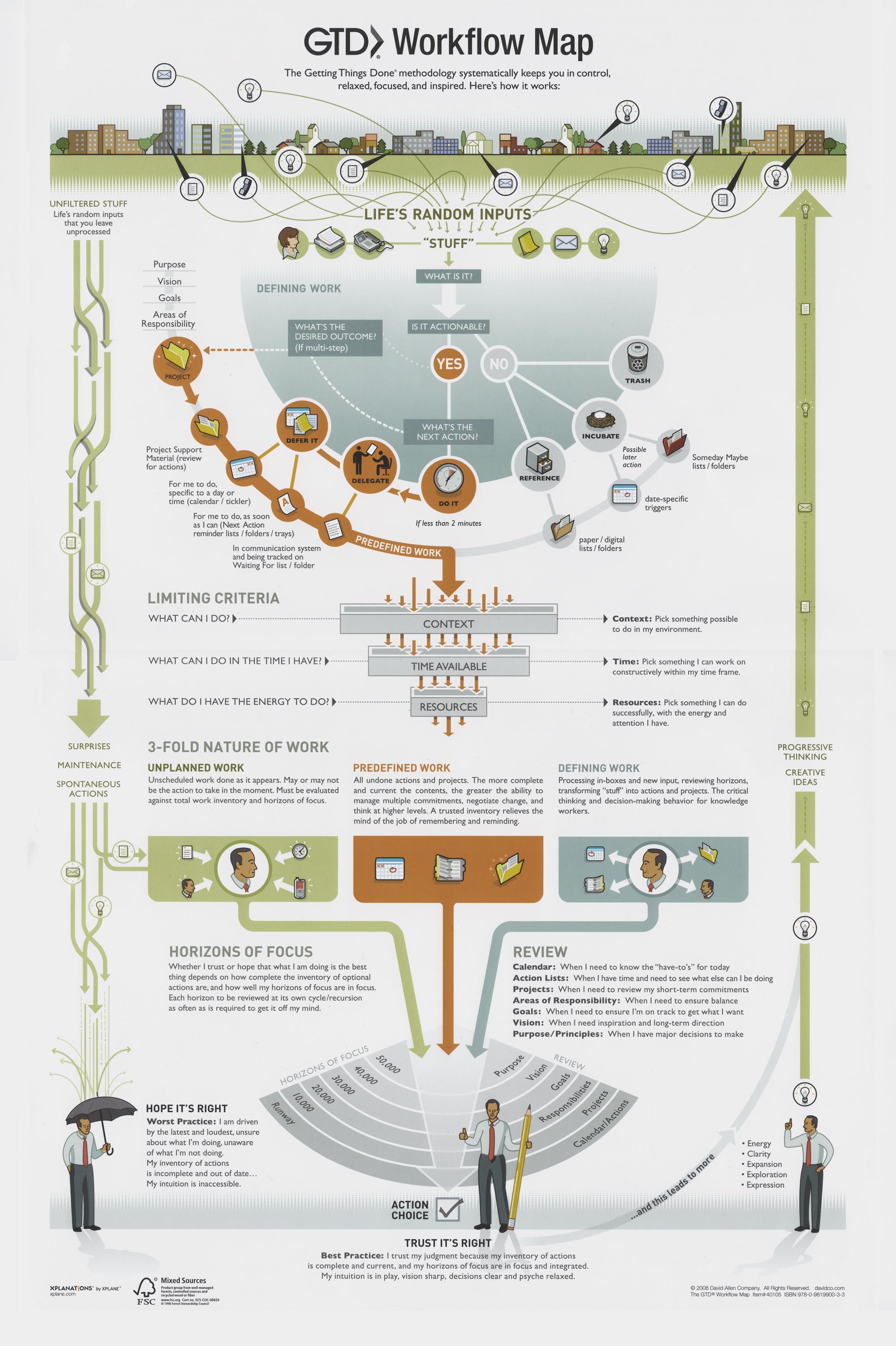
Image Source: